A drone is any aircraft that flies without a person sitting inside it. That is the whole definition. Everything else, the number of rotors, the camera, the price, is a detail layered on top. The FAA uses a clunkier term for the same idea: small unmanned aircraft system, or sUAS. In everyday conversation, drone means a battery-powered quadcopter you launch from a driveway, a field, or a boat deck. That single word covers a 135-gram palm-sized toy and a 1,063-gram cinema rig that costs more than a used car. Because the word is so broad, shopping is confusing until you split the category into types. Most first-time buyers overspend on the wrong type. If you are just starting out, our guide to the best drones for beginners is the fastest way to narrow the field.
The rules are where the types really separate. In the United States, any drone heavier than 250 grams has to be registered with the FAA, and most drones flying in US airspace now need Remote ID broadcasting. The FAA’s drone registration and Remote ID rules also set the line between recreational flying and commercial work. Fly for a client and you need a Part 107 certificate. Cross into Canada and the same job may need a basic or advanced pilot certificate instead. Weight is the number that decides most of this, which is why sub-250-gram drones sell so well. Our breakdown of drone laws in the USA walks through the paperwork step by step.
We compared five drone types on the specs that actually change how you fly: flight time in minutes, camera sensor size, takeoff weight in grams, and control range in kilometres. A drone that flies 18 minutes and one that flies 52 minutes are different tools, even when both shoot 4K. Sensor size matters more than megapixels, because a 1-inch CMOS gathers far more light than a 1/2-inch sensor at dusk. Weight decides where you can legally launch. Canada has its own weight classes, and the Transport Canada drone safety rules split drones at 250 grams for basic operations.
Here is the short version. Camera drones are the default for photos and video. FPV drones trade stability for speed and a headset view. Beginner drones are cheap, light, and forgiving. Thermal drones see heat and cost real money. Fishing drones are waterproof and drop payloads. All five share the same skeleton, a frame with rotors, a flight controller, a battery, and a radio link, but the design priorities pull in completely different directions. A racing pilot and a roof inspector both fly drones and would find each other’s machine nearly unusable. Pick the type first, then the model inside that type.
How Do the Top Options Compare?
| Drone type | Best for | Typical flight time | Camera sensor | Takeoff weight | Price check |
|---|---|---|---|---|---|
| Camera drone | Photos, video, and travel | 45-52 min | 1-inch CMOS or larger | 249-1,063 g | Check price |
| FPV drone | Immersive flying and racing | 18-23 min | 1/1.3-inch CMOS | 135-377 g | Check price |
| Beginner drone | First flights and practice | 12-20 min | 1/2-inch CMOS | 135-249 g | Check price |
| Thermal drone | Inspection and night work | 40-45 min | 640x512 radiometric thermal | 900-1,100 g | Check price |
| Fishing drone | Bait delivery over water | 15-20 min | 4K RGB | 2,000-3,500 g | Check price |
Flight times are manufacturer maximums measured in calm air at moderate speed. Real numbers drop 20 to 30 percent in wind, cold weather, or with a payload attached. Prices move constantly, so always check the current listing before you commit.
1. Camera Drones , Best for photos, video, and travel
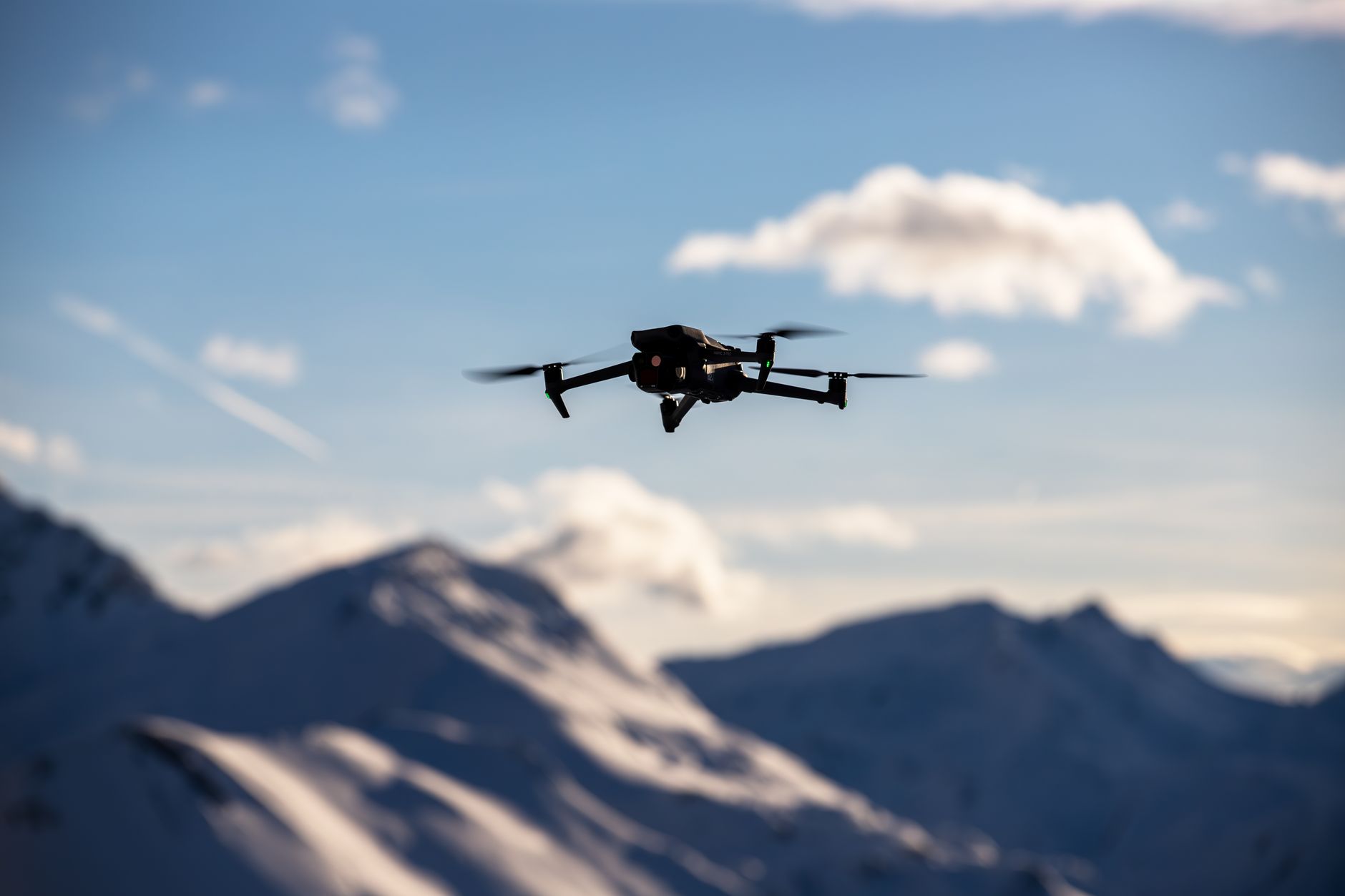
Camera drones are what most people picture when they hear the word drone. A gimbal holds the camera steady, GPS holds the aircraft in place, and the whole machine is built to hover while you frame a shot. The category splits by sensor size rather than by brand. The DJI Mini 5 Pro weighs 249 grams, carries a 1-inch CMOS sensor, and flies up to 52 minutes on one battery. Step up to the DJI Air 3S and you get two cameras, a 1-inch wide plus a 1/1.3-inch telephoto, 45 minutes of flight, and a 724-gram body that handles wind far better. The DJI Mavic 4 Pro pushes to a 4/3 CMOS sensor and 51 minutes, but it weighs 1,063 grams.
Range is rarely the limiting factor on the current generation. DJI’s O4 transmission is rated to 20 km in FCC mode, which is well past what you can legally fly, because visual line of sight is still the rule in the US, Canada, and Europe. What separates these drones in daily use is the sensor and the gimbal. A 1-inch sensor holds detail at dusk. A 1/2-inch sensor starts smearing the moment the sun drops. DJI publishes full spec sheets for every model, and the DJI product pages are worth reading before you spend anything.
There is a practical catch. Anything above 250 grams needs FAA registration and Remote ID broadcasting, and heavier drones mean more paperwork and fewer legal launch spots. Our guide to DJI drones compared lines the weight classes up side by side. If you want one recommendation, the Mini 5 Pro is what most photographers should buy first. Check the DJI Mini 5 Pro on Amazon.
Key strengths:
- ✅ Image quality that holds up: a 1-inch or 4/3 sensor keeps detail and controls noise after sunset.
- ✅ Long flight times: 45 to 52 minutes per battery on current models, against 15 to 20 on cheap drones.
- ✅ Stable GPS hold: the aircraft stays put in wind while you compose, which matters for video.
- ✅ Obstacle sensing: omnidirectional avoidance on mid-range models and up saves props and nerves.
- ✅ Real camera control: ND filters, flat colour profiles, and 10-bit recording for editing.
- ❌ Heavier models cross 250 grams, which triggers registration and Remote ID requirements.
- ❌ Cost climbs steeply with sensor size. A 4/3 sensor drone costs several times a sub-250-gram model.
- ❌ Batteries are pricey and lose capacity after roughly 200 to 300 charge cycles.
Who it’s for: Buy a camera drone if your goal is photos, video, or client work and you want the best image per dollar.
2. FPV Drones , Best for immersive flying, racing, and cinematic dives
FPV stands for first person view. You wear goggles, the drone streams video from a nose-mounted camera, and you fly as if you are sitting in the cockpit. Most FPV drones have no GPS hold and no automatic return to home. Cinewhoops like the DJI Avata 2 weigh 377 grams, fly about 23 minutes, and record 4K at 60fps from a 1/1.3-inch sensor. The motion is the entire point. Banking turns, dives through gaps, and low passes over water look nothing like a camera drone shot.
The trade-offs are real. FPV drones are louder, harder to fly, and much easier to crash. The Avata 2 includes propeller guards and a turtle mode that flips the aircraft back over after a tumble, which helps, but you will still break things. Range is around 13 km in FCC mode with the right controller and goggles, though flying beyond visual line of sight is illegal in the US, Canada, and most of Europe regardless of what the radio can do.
Two sub-types exist. Racing drones are stripped-down 5-inch carbon frames built for speed and nothing else. Cinematic FPV drones carry heavier cameras and get used for real estate walkthroughs and music videos. Both demand the same piloting skills. Our guide to FPV drones covers the goggles, radios, and batteries you need beyond the aircraft itself. The Avata 2 is the easiest way in. Check the DJI Avata 2 on Amazon.
Key strengths:
- ✅ Immersive view: goggles put you inside the flight, which makes proximity flying far more intuitive.
- ✅ Speed and agility: manual mode hits angles a GPS camera drone physically cannot reach.
- ✅ Crash tolerance on cinewhoops: ducted props and guards let you bounce off objects and keep flying.
- ✅ Distinctive footage: FPV shots stand out against a feed full of slow orbit videos.
- ✅ Compact and light: most FPV drones sit comfortably under 500 grams.
- ❌ Steep learning curve: manual mode takes hours in a simulator before you stop crashing.
- ❌ Short flight times: 18 to 23 minutes is normal, and aggressive flying cuts that roughly in half.
- ❌ Goggles, spare batteries, and a proper radio add serious cost on top of the drone.
Who it’s for: Pick an FPV drone if the flying itself is the fun part and you are willing to practice for it.
3. Beginner and Toy Drones , Best for your first flights and casual family video
Beginner drones are the cheapest way into the hobby and the least painful way to learn. The DJI Neo weighs 135 grams, flies about 18 minutes, shoots 4K at 30fps from a 1/2-inch sensor, and can take off from your palm. It also flies with no controller at all, using just the phone app, which is a neat trick for quick selfies and follow shots.
Cheaper options exist. Holy Stone and Potensic sell drones in the same weight class for a fraction of DJI money, with shorter range and no obstacle sensing. What you give up is transmission quality and stability in wind. What you keep is the ability to learn stick control without risking an aircraft that costs more than a laptop.
The legal side is friendlier here too. Under 250 grams, recreational flyers in the US do not need to register the aircraft, and Remote ID generally does not apply either. Commercial flights under Part 107 still need Remote ID regardless of weight, so a 135-gram drone flown for a paying client changes the picture completely. Sub-250-gram models are also the easiest drones to travel with, since several countries treat them more gently at the border. Check the DJI Neo on Amazon if you want the simplest start.
Key strengths:
- ✅ Low cost of entry: sub-250-gram drones start cheap, and spare props cost almost nothing.
- ✅ Forgiving to fly: propeller guards, low top speed, and light weight mean most crashes cost nothing.
- ✅ No registration in the US: under 250 grams, recreational flyers skip registration and Remote ID.
- ✅ Fast to launch: palm takeoff and app control get you airborne in under a minute.
- ❌ Small sensors: 1/2-inch and smaller struggle in low light and produce noisy dusk footage.
- ❌ Wind sensitivity: anything above roughly 15 km/h turns the flight into a fight.
- ❌ Limited range and no obstacle sensing on the cheapest models, which caps how far you can explore.
Who it’s for: Buy a beginner drone if you want to learn stick control without risking an expensive aircraft.
4. Thermal Drones , Best for inspections, search and rescue, and night work
Thermal drones carry an infrared sensor that reads heat instead of visible light. A roof leak, an overheating solar panel, a lost hiker in the dark, and a deer in a field all show up as bright spots against a cool background. The sensor is the expensive part. A DJI Mavic 3T pairs a 640x512 radiometric thermal camera with a 1/2-inch wide camera, flies about 45 minutes, and weighs 920 grams.
Radiometric is the word that matters. A radiometric thermal sensor records the actual temperature of every pixel, so you can measure a hotspot instead of only seeing it. Non-radiometric sensors show relative contrast and nothing more. If you plan to bill a client for an inspection report with numbers in it, radiometric is the one you need.
These drones live in commercial territory. In the US, flying one for a paying client means a Part 107 certificate, and the aircraft must be registered because it is well over 250 grams. There is essentially no recreational market for a 920-gram thermal drone. Our guide to thermal drones covers sensor resolution and what each price tier actually buys you.
Key strengths:
- ✅ Sees in total darkness: no lighting setup needed for night inspections or search work.
- ✅ Radiometric measurement: you can log real temperature values and build a genuine report.
- ✅ Long flight times: 40 to 45 minutes, matching a camera drone of similar size.
- ✅ Pays for itself: roof, solar, and electrical inspections bill well above standard camera drone rates.
- ❌ High entry price: the thermal sensor is the single most expensive component in the aircraft.
- ❌ Weaker visible-light camera: the RGB sensor on a thermal drone is usually mid-tier at best.
- ❌ Over 250 grams plus commercial use means registration, Remote ID, and Part 107 all apply.
Who it’s for: Buy a thermal drone only if you have paying inspection or public safety work to justify it.
5. Fishing and Payload Drones , Best for dropping bait and payloads over water
Fishing drones are a small but growing category. They are waterproof, they float, and they carry a release mechanism that drops bait or a line a few hundred metres offshore. The SwellPro SplashDrone 4 is the best-known example. It lands on water, takes off from water, and flies roughly 15 minutes with a payload attached.
Payload capacity is the number that matters. Bait delivery drones typically carry 1 to 2 kg, enough for a rig and not much more. Flight time drops as payload weight rises, so a 20-minute spec on paper often becomes 12 minutes in the air with a full load. Range is limited too, usually a few kilometres, because you are flying over salt water with no useful visual reference at distance.
Check the local rules before you buy. Dropping a payload from a drone counts as a commercial operation in many jurisdictions, and some countries restrict it outright. In the US, Part 107 covers most payload drops, and flying over people or moving vehicles is restricted. Our guide to fishing drones goes deeper on waterproof ratings and release mechanisms.
Key strengths:
- ✅ Waterproof and buoyant: these drones land and float, which no camera drone does.
- ✅ Payload release: a servo-driven mechanism drops bait or a line exactly where you want it.
- ✅ Saves casting distance: reach 300 to 500 metres offshore without a boat.
- ✅ Built for salt water: sealed electronics and corrosion-resistant motors survive repeated beach trips.
- ❌ Short flight times: 15 to 20 minutes, and less with a full bait load attached.
- ❌ Heavy: most weigh 2 kg or more, so registration and Remote ID always apply.
- ❌ Payload drops can be treated as commercial operations even on a casual fishing trip.
Who it’s for: Buy a fishing drone if you fish from shore and need to reach water you cannot cast to.
Frequently Asked Questions
What does drone actually mean?
A drone is any aircraft that flies without a pilot on board. The FAA calls the small ones sUAS, short for small unmanned aircraft system. The word covers everything from a 135-gram palm-sized toy to a 2-kilogram waterproof fishing drone.
How many types of drones are there?
Most consumer and commercial drones fall into five practical groups: camera, FPV, beginner, thermal, and payload or fishing drones. Military drones are a separate world with entirely different rules and price tags.
Do I need to register my drone with the FAA?
In the US, any drone over 250 grams must be registered, and every drone flown under Part 107 needs registration regardless of weight. Recreational drones under 250 grams are exempt from registration and from Remote ID.
What is the difference between a drone and a quadcopter?
A quadcopter is one shape of drone with four rotors. Drone is the umbrella term that also covers fixed-wing, hexacopter, and single-rotor aircraft.
Do I need a license to fly a drone?
For recreational flying in the US you pass the free TRUST test. Any paid work requires a Part 107 remote pilot certificate. Canada uses basic and advanced pilot certificates instead of Part 107.
How long can a drone stay in the air?
Typical flight times run from 12 to 20 minutes on beginner drones and 45 to 52 minutes on current camera drones. Cold weather, wind, and payload weight all cut those numbers.
What Should You Remember?
- Drone means any uncrewed aircraft. The word covers a 135-gram toy and a 2-kilogram waterproof fishing rig equally.
- Weight decides your paperwork. Cross 250 grams in the US and FAA registration plus Remote ID kick in.
- Camera drones fly longest. Current models reach 45 to 52 minutes per battery, versus 15 to 20 on entry-level drones.
- FPV drones are the hardest to fly. Budget simulator hours before you crash a real one.
- Thermal drones are commercial tools. Radiometric sensors let you measure heat, not just see it.
- Pick the type before the model. A racing pilot and a roof inspector need completely different aircraft.
This article is for general information only. Drone regulations vary by region and change frequently , always verify current local laws and airspace rules before flying.